Neighborhoods change. Yet while some changes are organic, other changes are manufactured, driven by the forces of the financial market. This artificial change uproots more than just material realities, it transforms the very identity of the community. While growth and progression is normal in cities just as it is for individuals, some change is brought on artificially, that is, it does not come about organically from within the community but rather external forces, one of the most prominent is real estate development. One of the driving forces for real estate-driven change is Speculation. Like other arbitrary yet fundamental elements of capitalism, the speculation on commodities is the key animator of the market.
To “speculate” is to place a bet on a future, to prefigure the potential of something. This process sets a dangerous incentive, encouraging and influencing the actions one chooses to take in the present, even missile strikes. When it comes to influencing the futures of neighborhoods, real estate developers and investors speculate on housing, literally banking on the returns they imagine one day to receive. As a result, speculation serves as the most powerful tool for accelerating changes in a community. At first, these changes may be welcomed. How can they not be? They come with flashy presentations, colorful diagrams and promises for a new neighborhood or city. Yet the quick selloffs that follow the speculative processes lead to the influx of new residents, displacing the old community who can no longer afford to live in the community they built, a process called gentrification.
Tucked beneath euphemisms like “improvement districts,” “economic development zones,” and otherwise so-called beautification projects, is much more than the changing of facades. Here are changes that profoundly disrupt the social ecology of a place, turning the co-existence of diverse neighbors into nothing more than potential profit margins:
“The concept of ‘blight’--a word with its origin in biology--was introduced by the urban renewal proponents as a rationale for reorganizing ownership in neighborhoods deemed “dangerous.” Vibrant communities of color were often destroyed by the urban renewal projects. Real estate speculators later bought up properties in “blighted” areas at depressed prices and promoted gentrification, further destabilizing established urban communities.” - Geographer Carla Leshne in Counterpoints.
Thus, the incentive or rather, the imperative, is to generate profit over anything else, but especially over safe and affordable housing conditions that don't serve profit margins. This leads to a system of mechanisms put in place to do everything possible to make property owners wealthy, while renters come second to the market. Think of speculation as the manufactured order that sets in motion the transformation of a neighborhood, kicking off the process of gentrification, the replacement of a community by a different culture of people.
Recently, Paterson’s biggest developer put 85 buildings containing 1,528 apartments on the market, about one fourth of his portfolio. Charles Florio, a non-resident owner who operates various shell LLCs in Paterson, touted this as “recycling capital” within the city to purchase even more properties. With about 500 properties in his portfolio, Florio owns a significant stock of the overall apartment buildings in Paterson that number around 1,100. While recycling is a positive term, it elevates capital over people's well-being in the city. The inevitable outcome is that the properties Florio will be selling off will generate significant capital gains or profits for him, leading to a higher tax assessment of these properties and inevitably increased rent, pushing many longtime residents outside of the city.
All of these words, like the capitalist market, seem abstract. What does speculation look like? What can speculation tell us about the potential for a place to lose its identity, for it to be gentrified? The following is an attempt to examine how speculation takes place and how it shifts the dynamics of a city, particularly Paterson.
Speculation is hard to visualize given that its impacts can only be seen in retrospect as it is a bet on the future. Groups like the Paterson Mapping project are developing ways to visualize what speculation looks like.
The “Speculation in Paterson” map puts together two important datasets: median household income and tax assessment data from 2005 and 2025. In doing so, we are able to visualize how properties become out of reach for the families who live in them. With nearly ¾ of the city’s residents being renters, they are left at the whim of the many outside property owners in Paterson.
We mapped the annual property tax rate of each parcel of land in the city as a percentage of the annual median household income across the city. Here the purpose is to demonstrate the ability of households to theoretically afford to own the building they are occupying. As you can see, the majority of the city is in red, meaning that many of the residents living in the city today can not afford the annual property tax rate on their own, with the majority of the annual property tax assessment being 20 times what the median household earns. Even considering that many of the properties are multifamily units, this over 20-fold increase demonstrates how artificial speculation in the city has valued properties far out of reach of the people who actually live in them.
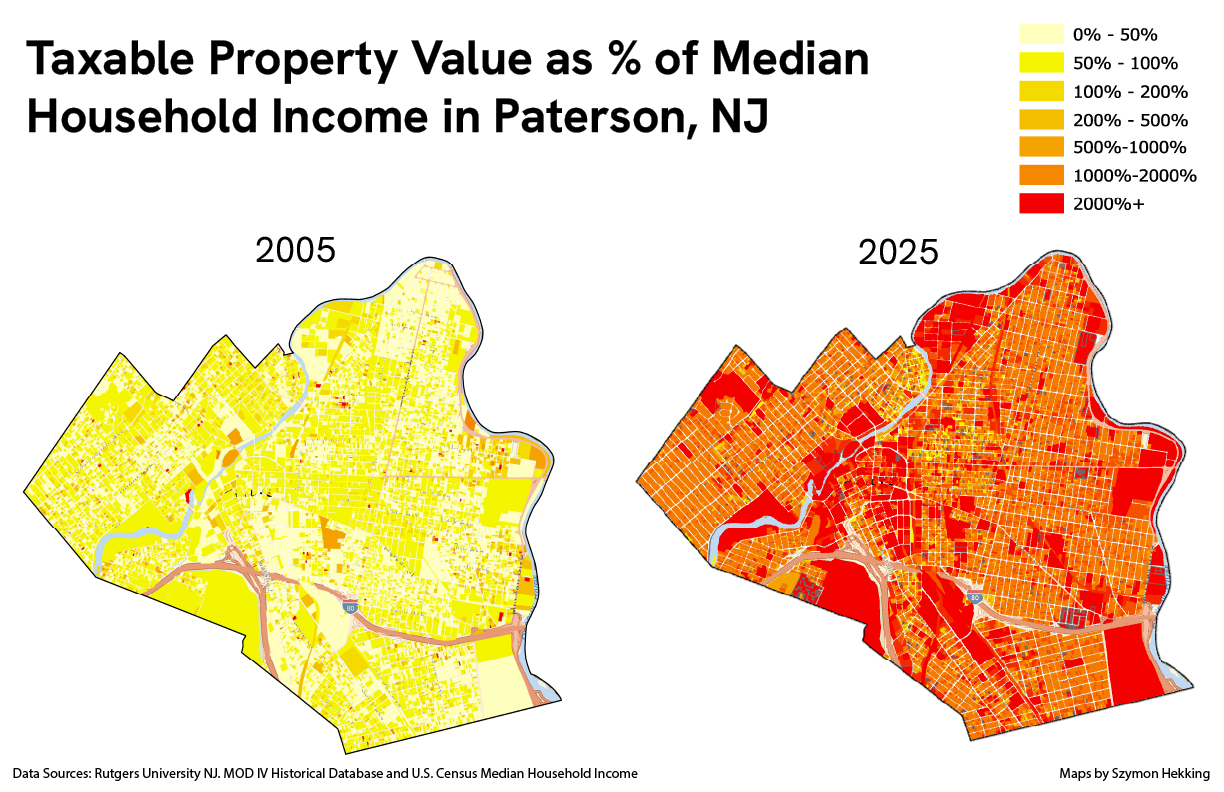
In the 2005 map, you can see that the ratio of median income:annual tax rate has dramatically increased since then. In 2005, the annual property tax rate could be covered with about half of the median household income in the city.
What does this mean? The map shows how residents in Paterson are sitting on properties worth far more than they would be able to cover by themselves, leaving them vulnerable to selloffs and displacement by the owners of the building. The high tax assessments in the city mean that developers are sitting on large stocks of property and ready to turn a profit at any minute, just as Florio is getting ready to do with the selloff of about a fourth of his portfolio.
A closer study of this map tells us something else. The reddest parts of the map, the ones with the highest tax assessment, are on the waterfront and downtown area. These are often the first areas to be speculated on, the frontlines of gentrification if you will. This story is reproduced over and over across the country, such as it did in Detroit over the last couple of decades.
We know something is wrong when our neighbors are displaced simply for being unable to afford a place. Or when the landlord, police and judge simply shrug their shoulders to imply that it is “just the way things are.” The psychoanalyst Lara Sheehi refers to the impact of these systems on us as the “psycho-political-affective” that creates fear, confusion and despair in us:
“The counterinsurgent work of the psycho-political-affective is to normalize the disciplining function of these colonial introprojects, conscripting us into carceral relation with and within ourselves and others. We discipline ourselves to cohere to a colonial logic that is structured around our debasement, distortion, and disfiguration.” - Psychologist Lara Sheehi in From the Clinic to the Streets
This thing we take for granted has a name--capitalism, an economic system built on the generation of profit through economic exploitation, primarily through the extraction of wealth and speculation of commodities, including housing, in the open market.
But things do not have to be this way. Speculation is allowed to take shape because housing is treated like a commodity, something to be bought and sold on the market. What if housing were treated as a right? What if it were collectively owned, or rather leased out rather than simply sold to the highest bidder? We have options, one of them is community land trusts. Community lands trusts are a way of taking housing out of the speculative market, keeping the neighborhoods and everything that we love about our neighborhoods intact. Community land trusts vary in structure but generally consist of member-owned land, with the ability to lease out the properties on it. The lease agreements often stipulate terms that benefit the neighborhood as a whole, such as capping the price the properties can be sold for, this allows the next buyer to be able to afford the neighborhood. Community land trusts offer affordable leases, allowing people to build equity while maintaining the integrity of the neighborhood.
We should not accept the conditions of the present--that places housing on speculative markets literally gambles away our future--as our only reality. We can do better.